

Why Manufacturers Need Real-Time OEE Monitoring
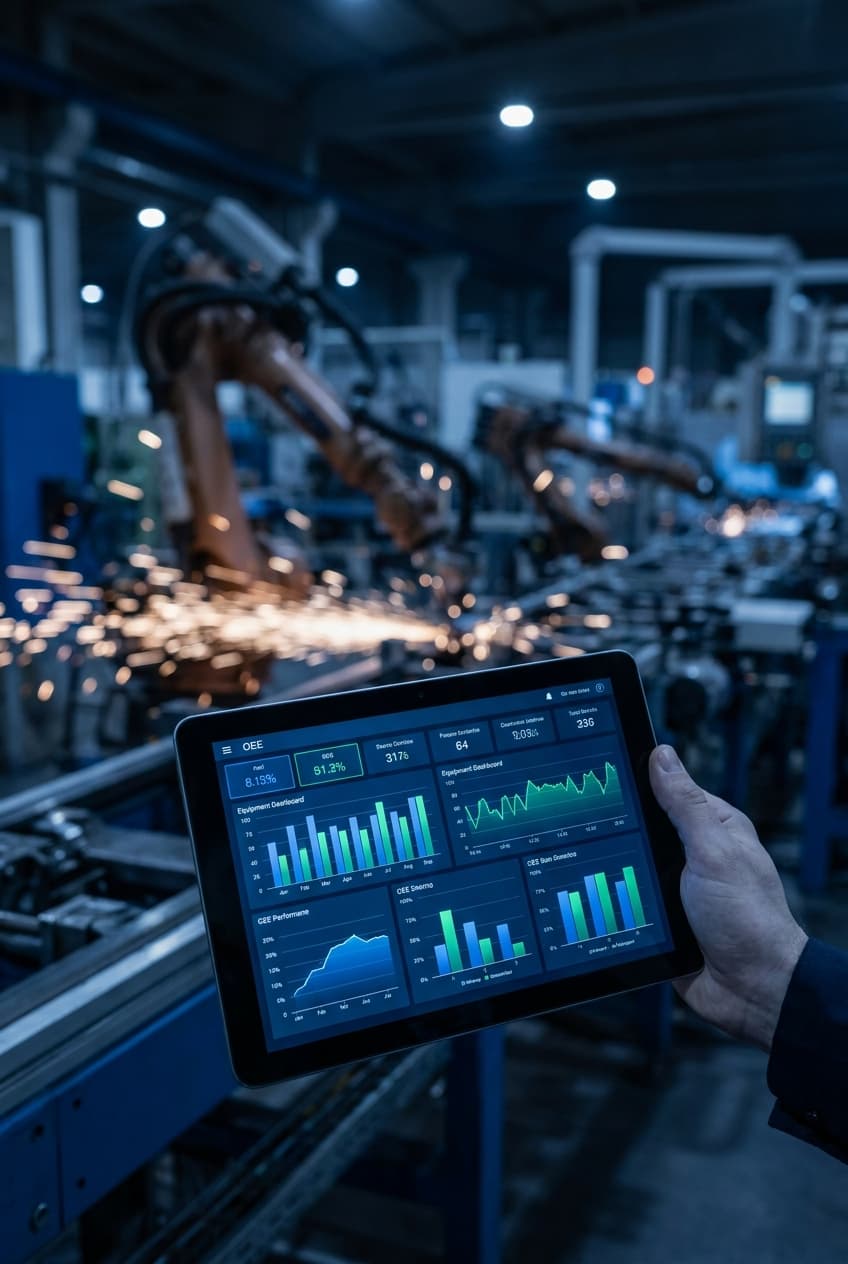
A look at how live Availability, Performance, and Quality tracking helps production teams catch downtime before it costs a shift.
The problem with end-of-shift reports
In most factories, the true story of a shift is written after it ends. A supervisor collects handwritten logs, someone types them into a spreadsheet, and the next morning management learns that Line 3 lost two hours to a jammed feeder and a slow changeover. By then the time is gone, the order is late, and nobody remembers exactly what happened.
This is still how many plants work, including a large share of the textile, packaging and food mills around Faisalabad, Lahore and Karachi. The machines are good and the teams are skilled, but decisions are made on yesterday's data. Real-time OEE monitoring closes that gap.
What OEE actually measures
Overall Equipment Effectiveness (OEE) answers a simple question: of the time you planned to produce, how much was truly productive? It combines three factors into one number:
- Availability: the share of planned time the machine was actually running. Breakdowns, changeovers and waiting for material all reduce it.
- Performance: how fast the machine ran compared with its ideal speed. Micro-stops and running below rated speed reduce it.
- Quality: the share of output that was good the first time. Rejects, rework and B-grade fabric reduce it.
How to calculate OEE
The formula is OEE = Availability × Performance × Quality. Take a loom planned to run for 8 hours. It stops for 1 hour, so Availability is 7 ÷ 8 = 87.5%. While running it produces at 90% of its rated speed, so Performance is 90%. Of what it produces, 97% passes inspection, so Quality is 97%.
OEE is 0.875 × 0.90 × 0.97 ≈ 76%. Each factor looks acceptable on its own, yet almost a quarter of the planned shift was lost. That is why OEE is useful: it shows the combined cost of small losses that are easy to ignore one at a time. An OEE of 85% is often cited as a world-class benchmark for discrete manufacturing, while many plants that measure it for the first time find themselves well below that.
Why real-time beats manual tracking
Manual OEE tracking is better than none, but it has three weaknesses. It misses short stops, because nobody writes down a 40-second jam twenty times a shift. It is slow, so problems are discovered after the damage is done. And it depends on people remembering and recording reasons accurately at the end of a long shift.
Real-time monitoring connects directly to the machine, through a sensor, a PLC signal or a simple pulse counter, and calculates Availability, Performance and Quality continuously. The benefits are practical:
- Supervisors see a line slowing down while there is still time to act, not the next morning.
- Micro-stops become visible, and on high-speed lines they are often the single biggest loss.
- Downtime is captured automatically, so operators only add a reason for longer stops.
- Shift, line and product comparisons are fair, because every line is measured the same way.
- Maintenance can be planned around patterns in the data instead of reacting to breakdowns.
What this means for textile mills
Textile production makes OEE especially valuable. Looms, knitting machines and stenters run long hours, small stops repeat constantly, and quality is graded, so a machine can be "running" while producing B-grade fabric. Linking machine performance to inspection results shows where speed is being bought at the cost of quality.
Older machines are not a barrier. Many mills run equipment that is 15 or 20 years old with no modern controller. Retrofitting a low-cost sensor to count cycles and detect stops is often enough to start measuring OEE without replacing anything.
How to get started
You do not need to connect the whole factory on day one. A practical rollout looks like this:
- Pick one bottleneck line where lost time directly delays orders.
- Agree on planned production time, ideal speed and what counts as a reject.
- Connect the machines and run the system alongside your current reports for two to four weeks.
- Review the top three loss reasons with the team every week and fix the biggest one first.
- Expand line by line once the numbers are trusted on the shop floor.
How EnicSoft OEE helps
We built EnicSoft OEE, our own real-time production monitoring platform, for exactly this problem. It turns live sensor data into Availability, Performance, Quality and OEE per line and shift, classifies downtime automatically, and adds shift management, reporting, energy monitoring and carbon-emissions tracking on top. If you run a textile mill or production plant in Pakistan and want to see your real OEE, we can help you start with a single line.
Want help with this? See our Industrial IoT & OEE service or book a free 30-minute call.